Friday, February 1, 2019

"...and So It Goes" - Part 3 (of 3)

With my older son away at college, I’ve been heartened by the maturing and strengthening of the bond between us despite his “new normal.” Still, I sometimes lapse into moments of self-reflection as to our earlier years of attachment struggles, further reassuring me with hope for the future and our relationship.

https//www.adoptivefamilies.com/adoption-bonding-home/and-so-it-goes-father-of-college-student-reflects-older-childs-transition-to-family-attachment-struggles/?utm_source=eletter&utm_medium=email&utm_campaign=Feb19

While making my older son’s bed before he was due home from college for Thanksgiving break, it was as if time took a backwards swing. I last made his bed the night before I left for Brazil to meet him and his brother, then twelve and nine years old. Eight years later, still the same one, but the bed’s comforter is now worn and faded, and flaccid to the touch.

From the start, Matt was excited to have his own room, his own personal space unlike anything he ever had before, but its subdued environs were anything but tranquil for him. For the first few years, Matt only used his room during the day; at night he slept on the spare bed in his brother’s room. Unspeakable, blurred memories of his earlier childhood seemed to scream the loudest during the stillness of the night. Soft music playing on the radio and nightlights were mainstays in getting him to sleep on his own. And he’d incubate himself each night with his comforter, as if it were a cocoon, only to emerge anew, unharmed, the next morning.

During the day, Matt enjoyed the solitary confines of his room as a quiet place to play with his Legos, draw, and listen to the radio—but only of his own volition. As I shared in my memoir, See You Tomorrow…, timeouts in his room only added more fuel to his over-heated fury, like a caged animal consumed with his desperation to escape. Many hours were spent trying to stop him from punching more (or bigger) holes in the walls and doors and talk him down. An hour could go by with my keeping a secure hold on him, still struggling to calm and relieve him of his fright and narrow-minded focus on wanting to flee. “When you are able to speak in a calm voice…” “be still…” “talk to me…” were phrases I’d repeat over and over like a broken record that would eventually subdue his hostility and aggressive posturing.

Even when I wasn’t the target of Matt’s enraged behavior and hostile attitude, I often felt used, as if I were there simply for his convenience—to give him money, drive him around, and keep things going according to his schedule. With the wearing down of my stamina, I began to feel numb inside, feeling little or nothing for him at times. How could I when his wall of defenses seemed impenetrable, and he seemed determined to keep me on the periphery?

And yet, I went through the motions; I strove to be “there” for Matt, just as I strive to be “here” for Lucas, now a sophomore in high school. I attended his events, asked for his input on family matters, threw out hit and run tips in efforts to guide him, and gave him kudos for any good deeds or accomplishments. I tried to maintain a precarious balance in negotiating Matt’s earlier history of relationship disruption and staying tuned into and accommodating his need for control. But a year or two before Matt left for college, there seemed to be a lightening of his mood and more purposeful effort on his part to relate; it was as if seeds that were sowed and nurtured over the years began to bloom.

We were bonding again, and memories of any past misgivings would be waylaid at the mere sight of him, fronted by his broad smile. When I picked Matt up at the airport, I got a real hug, and we chatted the whole way home in the car—a half an hour! And he didn’t just chat with me; he was forthcoming with everyone throughout the weekend. He also was interested in partaking in whatever was on the agenda, even volunteering, without any ulterior motive, to go with me on a run to the grocery store.

Sadly, even with the strengthening of his relationship with me, Matt and Lucas had grown more distant over the past year. While they embraced when they first met up again, relations between them continued to stall over our long weekend together. As if the brothers had traded roles, Lucas now seemed circumscribed to lurking in his brother’s shadow. When they first came from Brazil, Matt’s adjustment difficulties were more readily apparent than his younger brother’s. With his speech impediment, it was tougher for him to learn English and express himself. Lucas had no such trouble, becoming functional with the English language in just two months and well-known and regarded for his articulate, outspoken ways soon after. Over the past year, however, Lucas had been struggling in school, and become more isolated and withdrawn. There were times he seemed unnerved by his own life’s sour turn in contrast with his brother’s newfound confidence.

Throughout the break, I’d catch Lucas staring at his older brother at times, as if daring him to unleash his angry side. In contrast, Lucas had always kept his true emotions hidden beneath his outward charm and the intensity, depth, and sharpness of his intellect. With Matt, I endured years of his self-righteous indignation, harsh verbal lashings, vicious slamming of doors or pounding on furniture—but at least he expressed his anger. Perhaps feeling freer with his brother away, Lucas has been expressing his anger more directly, even explosively.

Unlike his brother’s extroverted ways, Matt was fine with leaving others in doubt as to the profundity of his awareness, wit, and insight. He also was quick to claim indifference rather than risk failure and/or rejection for his efforts or interests. Where his brother positioned himself as the authority on all matters of the world, Matt tended to shrink back for fear that he couldn’t compete. The obvious strengthening of Matt’s self-confidence, not to mention his willingness to put himself more “out there,” has been nothing short of miraculous. Even his speech seemed clearer and more intelligible, and I wasn’t the only one who noticed. He cares now; he was afraid to care before.

And just like that, the weekend was over and I was back at the airport with Matt for his early flight back to school, where I again choked up. As I reached to hug him goodbye, the familiar wave of longing flooded my emotional bearings and I felt myself folding like a house of cards. Though it might have been hard to see through my own tears, I believe I saw a glint in his eyes as well before he hastily turned away and made a beeline for the terminal’s entry doors. But I was “fine”; I had already been through this and will undoubtedly do it again a countless number of times.

On the drive home, ignoring the empty seat beside me, I recalled how I had found Matt that morning, fast asleep in his bed with his comforter covering him from head to toe. “Still?” I thought, surprised at first. But as I gave it some thought, I wondered about what really mattered in the grand scheme of life. Old habits might die hard, but perhaps understandable when their initial function was so fundamental. I guess no matter how things might change for the better, there still are rudimentary needs deeply ingrained and influenced by life’s experiences. Even if it sometimes means heeding the urge to take cover under the reassuring, protective folds of one’s security blanket.
GARY MATLOFF, PH.D., is a licensed psychologist and nationally certified school psychologist. He adopted nine- and 12-year-old brothers from Brazil as a single father, and chronicles his family’s story in his memoir, See You Tomorrow . . . Reclaiming the Beacon of Hope. Dr. Matloff has also been published in Kveller, parent,co, Adoption Today, APA Monitor, National Council for Adoption’s Adoption Advocate, and Portrait of Adoption. Find him online at drgarytheadoptiveparent.blogspot.com and psyched4kids.com.


Saturday, January 26, 2019

"Because they have likely had multiple disappointments in their lives, older children may take longer to form deep and enduring attachments. The older child is at the time of adoption, the more likley it is that he or she has experienced not only rejection but also insecurity related to multiple foster care placements and temporary relationships. He or she may feel unlovable or dispensable as a result and question your commitment and the permanence of the adoption (Matloff, 2014). This can cause your child to actively resist your affection or test you to make sure your love is real and permanent (Kupecky, 2014). This may come in the form of angry outbursts or withdrawal. It is important to recognize these behaviors as a process your child needs to work through and not take them personally."

Helping Your Child Transition from Foster Care to Adoption: a Fact Sheet for Families
via the Children’s Bureau: Child Welfare Information Gateway – July, 2018

Courtesy of: Matloff, G. (2014) The Joys and Challenges of Parenting Older Adopted Children, Adoption Advocate, 77. Retrieved from the National Council for Adoption website (http://www.adoptioncouncil.org/publications/2014/11/adoption-advocate-no-77

Thursday, November 29, 2018

"...and Letting It Be" - Part 2 (of 3)

Image result for adoptive families magazine When I adopted my two sons eight years ago, they couldn’t separate themselves fast enough from their “old” life in Brazil. As I prepared to visit my oldest son two months into his “new” college life—a lifetime for any freshman—I wondered to what extent he might have compartmentalized his now “old” family life.

https://www.adoptivefamilies.com/parenting/older-child-teen-adoption-college-transition-new-relationship-letting-it-be-part-2/

author Gary Matloff visiting his son, adopted as an older child, as a freshman at college
A continuation of: “The Fine Line Between Letting Go and Being Let Go”
Even though my older son, Matt, mostly kept to himself in the house, with his younger brother, Lucas, the chatty one, a deafening silence permeated the atmosphere upon our return home from dropping him off at college. The air in Matt’s room seemed especially lifeless—though not for long. Lucas didn’t waste any time seeking out his brother’s room for his personal study and music space. “Just hear me out,” he teased, though I could see there would be no talking him out of it
Stifling a roll of my eyes, I listened and offered a few ground rules: he must keep his brother’s room neat and use it only for homework, studying, and practice. I drew the line at his request to rearrange the furniture, reminding him that nothing was to be “changed.” If not for his brother, then for me… at least for now.

And though waves of emptiness would wash over me when I’d least expect, I rode each wave back to life as the new normal. Lucas maintained his ambivalence toward his brother, and I quickly learned to sidestep his impassive stares of “So?” or sarcastic retorts of “good for him” to any tidbits about his brother.

Though contact with Matt was sporadic, and about what he needed from me at first, he also called with news, like “I got a B on my first college essay” or “I got the (part-time) job,” as he was expected to take financial ownership of his casual social activities. He even summoned me for a Facetime chat to “meet my new roommate” when his first roommate didn’t work out. Texting still was his contact of choice, such as announcing, “Just ran my first five-mile race and did pretty well,” or sending a picture of himself with the caption, “Made my costume for the renaissance festival.” These random reach outs more than made up for not hearing from him for days at a time, or his minimal (if at all) responses to my texts and care packages.

I still treaded carefully, not daring to tease too much from him. Conversations were mostly one-sided; he would determine their focus before saying an abrupt “Byeeeeee” to signal that he was done. He never asked about our lives on the home front, as he ordinarily avoided expending emotional investment in others—perhaps for fear that he wasn’t worthy enough for the sentiment to be returned. It was still his way; as such, he’d primarily seek me out for my approval and validation for his “Good Job!”
***

The college’s family weekend was fast approaching, but it was over a Friday and Saturday; it would be difficult to take off work that particular Friday and I had tickets for Lucas and I to see Phil Collins that evening, purchased months before. Disappointing one son over another was not an attractive prospect. Never mind that I had waited only a few decades to see Collins in concert and it wasn’t likely I’d get another chance. To further help my cause, I’d gotten mixed reviews about these college family weekends in general, and Matt didn’t seem all that excited about any of the activities.

I offered to visit the weekend he had his fall break instead, but I was taken aback when he announced that he was going to his “girlfriend’s” house, and he’d “had these plans a long time. I am going to New York,” he decisively stated. I struggled to nurse my bruised feelings and remind myself that it wasn’t about me. Still, I persisted with my ongoing drive to expand his awareness of others’ feelings. It was a familiar hit and run plunge for me—I’d dive in with my point, break into the murky waters of his egocentrism, and swim decidedly to shore. I told him that I felt a little “yucky” about his lack of interest in my coming to visit, but that I’d be fine with whatever he decided: having me come up the second day of the family weekend or come for the extended fall break weekend. But he had to let me know soon.

I didn’t mention that not coming up at all was even a thought; it would have connoted hard feelings and he would inevitably detach himself from the situation rather than risk emotional vulnerability.
“Yea, whatever” he said, his standard reply. He was going to have to think this through on his own.
A few days later, he texted that he preferred the fall break weekend. With an unseen eyebrow raised in surprise, I asked what had happened to his plans. He replied that he couldn’t go because he had a cross country meet that Saturday, and I should come see him run rather than do the family weekend. He was likely not keen on being left alone and bored through the break; my coming seemed like a matter of convenience for him, but I was still a preference. And rather than participate in a string of activities that did not hold much relevance to his new college life, the focus on attending his meet seemed more meaningful to him. Progress!
 
***
Barely 24 hours before my flight to the mid-Atlantic, Matt texted a picture of the online prompt for me to check in. Though there was no message, the photo spoke volumes to me. He was anticipating my arrival, and he dared to express as such. Huge! I kept it cool and simply responded, “I am so excited!” He responded a short while later, “It’s cooooold!” He was happy.

As I landed, my excitement gave way to nervousness. The first two months is a lifetime for any college freshman, with all the adjustments, changes, and new experiences. And yet, Matt had already dealt with such in the form of unrelenting hardship several times over. When I walked into my sons’ lives eight years ago, Matt (and Lucas) couldn’t separate themselves fast enough from their “old” life in Brazil to their “new” American family life. The extent to which he might have compartmentalized his now “old” family life from his “new” college life remained to be seen. I really had no idea what would be in store for me.

I made it to the site of his meet with seconds to spare. I spotted my son as the starting gun fired. He was instantly recognizable, yet looked different to me somehow.

I blindly followed the other parents and coaches to the different vantage points of the open track field to cheer on the runners as they made their way around varying loops, and up and down the small hills of the makeshift track. At the second vantage point, I caught Matt beaming as he apparently had spotted me. He ordinarily never smiles while running; it “breaks his concentration.”

With most students gone for the break, it was quiet back on campus. But we packed our long weekend with our usual fall festivities: apple picking, a haunted trail walk at night, hiking, and cool restaurant eats.

In our relations together, Matt was almost chatty and unusually open to questions. I felt like he let me in on more of his life from the past two months than all four years of high school. Even when silence reigned, it was the comfortable kind.

Eight years ago, I stood in front of a closed door at my sons’ orphanage, just seconds away from meeting them. As I described in my memoir, See You Tomorrow…, I vividly recall how scared I felt. Aside from a few pictures, and a brief synopsis of their backgrounds, Matt and Lucas were complete strangers to me, as I was to them. Flashing forward eight years, I feel as though I might be getting to know Matt all over again, but with fewer distractions and without the burdensome weight of his earlier life’s struggles. My son was moving forward, not as fearful of his surroundings; he was taking charge of himself and becoming more comfortable with the broadening of his horizons. Maybe eight years was just enough, after all.
GARY MATLOFF, PH.D., is a licensed psychologist and nationally certified school psychologist. He adopted nine- and 12-year-old brothers from Brazil as a single father, and chronicles his family’s story in his memoir, See You Tomorrow . . . Reclaiming the Beacon of Hope. Dr. Matloff has also been published in Kveller, parent,co, Adoption Today, APA Monitor, National Council for Adoption’s Adoption Advocate, and Portrait of Adoption. Find him online at drgarytheadoptiveparent.blogspot.com and psyched4kids.com.

Monday, October 29, 2018


The Fine Line Between Letting Go and Being Let Go - Part 1 (of 3)  


I adopted my son as he was entering his teen years, and now, too soon, I have seen him off to college. How will his still tenuous attachment play out when I’m no longer a constant, physical presence in his life?

https://www.adoptivefamilies.com/parenting/older-child-teen-adoption-fine-line-between-letting-go-being-let-go-college-transition/

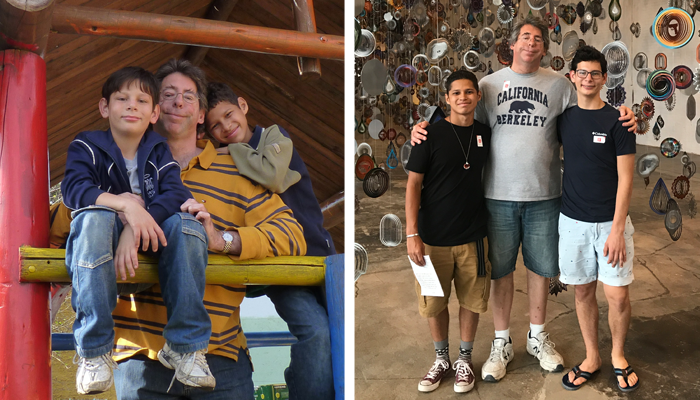
author Gary Matloff with his sons, after adoption and now, as teens

It’s a spectacle I’ve become familiar with over my years as a school psychologist. On the first day of each new school year, and for several days after, a small crowd of parents stands at the school’s closed front gates, watching their children walk off to their new classrooms.

This year, I missed the first few days of school to take my older son to college. When I returned to work, on the fourth day of school, I still felt emotionally spent from my trip. As I approached the school and spotted the small gathering of parents still holding on at the front gates, I felt an ironic twist. In years past, my sympathies would have hardened by now. “Let go, already,” I’d imploringly think to myself. This year, I felt I was right there with them.

I adopted "Matt" (with his younger brother, "Lucas") from Brazil as he was turning 12 years old. When adopting an older child, parenting starts off late in the game, yet the parenting paradox is the same: wanting to deeply attach to and invest in your child while eventually having to “let go” and preparing him to live his own life.

It’s an understatement to say that it was a struggle to get to this point with my son at all, with our relationship marked by disruptive attachment issues. But I held on through the explosive outbursts, purposeful resistance to academic achievement, and indifference to others’ feelings. I became less fearful of Matt’s struggles to reconcile with his earlier history of loss, trauma, mistrust, and a heightened need for control. I also gave up on my need for any immediate parental gratification, learning instead to appreciate the gradually emerging bond between us.

As I relaxed, Matt did too. Instead of keeping a tight lid on anything he thought about or did, he began to share more. When he did, I had to keep a lid on my wanting “more,” for fear he’d immediately retreat. I had to practice the same restraint whenever Matt expressed any physical affection: coming up from behind me with an awkwardly impulsive squeeze of my neck or face or being more gentle with a one-armed hug or a lean-in to my side, Sometimes I’d be allowed to reciprocate and other times I’d just have to stand there in quiet acceptance.

In the weeks leading up to our departure, the kid who resisted doing his work, chores, or anything else he didn’t want to do took total charge in handling his preparatory college tasks. He even cleaned out his room, and kept it neat. I became used to his customary retreats and resistance to encouragement as the thought of taking any risk was too threatening after a childhood full of hurt and disappointment. Occasionally, he approached me with a question or request for assistance, but I didn’t have to do anything. My son usually resisted direct influence, yet I learned to set things in motion behind the scenes, as when I asked the soccer coach at the start of high school to invite him to try out. The kid who still is wary of the past, having kept him from even thinking about his future, was ensuring his readiness to move forward in life.

I’d like to say that I was ready for him to go, but like any parent about to send his child out into the broader confines of life, I was plagued with a nagging fear of the unknown. And as an adoptive parent of an older child, I was apprehensive about how his still tenuous attachment to me and to our family would play out in the ensuing years, when I’d no longer be a constant, physical presence in his life. I was feeling unfinished; eight years didn’t seem enough, and I was having trouble with “letting go.”

***

In heading out on the morning of our departure, I knew better than to ask if he’d like to take “one last look” around the house. But I asked anyway and received the expected “Nah” in response. I hadn’t even turned out the lights before Matt had squeezed in with his brother in the front seat of the packed car. I feigned a feeble “Hold on, I forgot something” as I suddenly felt the urge to retreat backwards.

I went back inside to take a quick look at Matt’s uncharacteristically uncluttered bedroom. I fought back some tears as I flashed back eight years to the night before my departure for Brazil, when I had stood silently in the shared entryway, peeking into the neatly made up bedrooms awaiting their occupants. As I detailed in my memoir, See You Tomorrow, I can vividly recall the “picture perfect” image of how “the comforters were neatly folded, pillows fluffed, pictures hung straight, and toys, games, and books (were) smartly arranged.” Though Matt had left some personal artifacts scattered about, and had firmly told me several times over the preceding weeks that he didn’t want “anything changed,” I wondered if he had purposefully left his room roughly how he first found it—unlived in.

I couldn’t help but wonder whether my son ever really lived here. Having adopted him at the cusp of his teen years, the pseudo sense of independence Matt projected from the start was often naively ascribed to a developmentally normal phase. I knew better. He had to be tougher on the outside and hide his fear of intimacy. Though this instinct has relaxed somewhat over the years, Matt persists in his tendency to keep others at a comfortable distance.

Having regained my composure, we set off. First we’d be dropping Lucas off for his first day as a high school junior. The ride to Lucas’s high school would be short and quiet; relations between the brothers had become increasingly ambivalent over the past year. Both had repeatedly expressed their relief, if not happiness, over letting each other go their separate ways since the college choice was made.

Used to Lucas taking control over the car radio with his personal, rather eclectic, musical playlist, at first I didn’t think much of his dabbling that morning. But as I listened to his selection, the Eden Project’s “Times Like These,” tears began to flow. “It’s been a long, long time, we’ve come a long, long way… The future’s so bright. This is our time. Imma live it how I dream… It’s taken so long to feel okay.” I kept my gaze fixated on the road, terrified of disrupting a private moment between brothers, whether they knew it or not.

I was sobbing quietly as the song reached its ending: “Because it’s all we know. And it’s only change. Sun sets on the old. But we’re nocturnal anyway. And this is how we will know it’ll be okay. There are times we will hold when our memories fade. Sometimes it takes times like these to know you’re in the right place.” By the time we reached the school, neither had said anything, I had dried up, and their goodbyes to each other couldn’t have been more awkward. “Well, have fun in college,” Lucas simply said. I could barely hear Matt’s mumbled reply, something akin to his usual “Yea, yea, whatever.” So much for my idealized television sitcom moment.

***

The move-in the following day went fairly smoothly. Matt held onto his minimalist ways, save for his oversized Brazilian flag covering the wall space above his bed. His roommate wouldn’t arrive until the next week, but Matt decided to stay in his half-empty dorm room rather than come with me to the hotel that night, our last together; he had his first cross-country practice early the next morning, and was anxious to be on site and ready. It was OK—I could still tell him that I would “see him tomorrow.”

While Matt was at practice, I picked Lucas up at the airport. I had flown him up so that he could check out his brother’s new surroundings at the college, for them to have a more meaningful parting of ways, and for moral support and company for the drive home. After a parting lunch in the dining hall, before I knew it, it was time to bid my son goodbye.

I really thought I was going to be OK. After all, I had certain things I wanted to say, and had rehearsed them in my mind to keep my words brief and not overly sentimental—but after several false starts, all I could do was reach out to hug him. Even so, I held on for too long, until he softly pushed me away, simply claiming “that’s too much.”

Lucas intuitively came to both our rescues with a “Come on, Father,” although not before they both surrendered into a quick hug. Perhaps they’d declare something of a truce. Their ties to each other are, after all, inescapable.

When we got in the car, we found that Matt had left his new water bottle. We summoned him back down and I steadied myself for a redo. I motioned for Matt to come over to the driver’s side, where he looked at me expectantly, and dare I say patiently, for me to finally get out an “I love you.” He responded in kind with his trademark “yea, yea”—but no “whatever”—as he bounced back up the walkway steps. There, surprisingly, he stopped and turned around, smiling somewhat laughingly back at us as we goofily waved to him.

I then watched in what felt like slow motion as a huge piece of my life, a big part of what makes me who I am, break away. I knew it was right, I knew it was supposed to happen, but I didn’t want to let go…but knew I had to.

***

On the drive home, I asked Lucas about his song choice the few days before. As is typical for him, he immediately launched into an intellectualized discourse about its origin as a tribute for the songwriter’s fans struggling with his decision to leave behind “Eden Project” for the new name “Eden,” and a different musical style. Lucas’s understanding was that he wrote the song as a vehicle to express his feelings and reassure his fans that change is normal, and they shouldn’t worry because he was in the “right place.”

Lucas avoided discussing how the song made him feel, but added that he thought it might be a “comfort” to his brother as he embarked on the next phase of his life. As we talked, he replayed the song. I started to tear up again, and I struggled to tell him how deeply the song had touched me. As if on cue, Lucas said that he’d also seen his brother cry when it had played.

“He really cried?” I asked, with obvious incredulity in my wavering tone. “Yeah,” Lucas coolly replied.

Keeping it in perspective, I was reassured. Matt was looking forward to a “brighter tomorrow”; he wasn’t as fearful of the past as he used to be. I had done my parenting job well enough, but also knew that it wasn’t finished. Somehow, I had become that secure base Matt never thought he’d need, but deep down had always wanted.

Almost from the start of our first days together, Matt would unfailingly utter, “See you tomorrow” every night at bedtime. It soon became our ritual, our family anthem, seemingly serving as a declaration that “stability shall reign” to counter a prolonged earlier history of familial instability. As time passed, and Matt started taking more stock into tomorrow’s promise as opposed to its foreboding, he no longer needed to speak those words of comfort. And as I remained a constant for my son over the ensuing years, he grew to trust that I would be there, no matter what. I knew this trust was in place because, otherwise, he wouldn’t have been able to let me go as he did…never mind whether I’d have been able to let him go as I did.

GARY MATLOFF, PH.D., is a licensed psychologist and nationally certified school psychologist. He adopted nine- and 12-year-old brothers from Brazil as a single father, and chronicles his family’s story in his memoir, See You Tomorrow . . . Reclaiming the Beacon of Hope. Dr. Matloff has also been published in Kveller, parent,co, Adoption Today, APA Monitor, National Council for Adoption’s Adoption Advocate, and Portrait of Adoption. Find him online at drgarytheadoptiveparent.blogspot.com and psyched4kids.com.


Wednesday, October 4, 2017

Playing the Parenting Game for Keeps

When Brazil faced Germany for soccer’s World Cup finals, it was the pinnacle of Brazilian pride in our household...

https://www.parent.co/playing-the-parenting-game-for-keeps/

Thursday, July 27, 2017

Building Families One Adoption at a Time as printed in the
American Psychological Association (APA) Monitor

http://www.apa.org/monitor/2017/05/building-families.aspx


Monday, July 24, 2017

Kramer vs. Who?

I caught the movie “Kramer vs. Kramer” the other day. I first saw the movie when I was a young teen in the 1970’s, too young to really understand its significance at the time. Now though, as a single adoptive father...     

https://www.parent.co/kramer-versus-who/

Father and His Two Children Playing on the Beach

Wednesday, February 3, 2016

Saturday, January 9, 2016

Preserving the Role of the Adoptive Parents in the Midst of Adoption's Divergent Forces


Wednesday, December 3, 2014

For those who might have wondered what really went down when I won the state association's School Psychologist of the Year award, check out my latest posting on Kveller - I Missed a Major Career Milestone, But At Least I Was With My Kidshttp://www.kveller.com/blog/parenting/i-missed-a-major-career-milestone-but-at-least-i-was-with-my-kids/

Sunday, November 30, 2014

For the last day of November's National Adoption Awareness Month, here's an ode especially to new adoptive parents from the ever so relevant, Dr. Seuss: 

Sunday, November 23, 2014

I was so pleased to have been invited to contribute to the Social Work License Map's website - Life Lessons My Adopted Children Taught Me:  http://socialworklicensemap.com/life-lessons-my-adopted-children-taught-me/

Wednesday, November 19, 2014

Here's my piece for the Thirty Portraits of Adoption Series in honor of November's Adoption Awareness Month - Playing Behind the Scenes: Life as a Single Adoptive Father:  http://www.chicagonow.com/portrait-of-an-adoption/2014/11/playing-behind-the-scenes-life-as-a-single-adoptive-father/

Monday, November 10, 2014

Here's part 2, the Christian side of our family life posted on Kveller - My Adopted Son Wants to Be Christian--And I Need to Let Himhttp://www.kveller.com/blog/parenting/my-adopted-son-wants-to-be-christian-and-i-need-to-let-him/

Monday, November 3, 2014

Check out and share my article, The Joys and Challenges of Parenting Older Adopted Children in November's issue of the Adoption Advocate (77):  www.adoptioncouncil.org/files/large/74006f69a8fa720

Saturday, October 25, 2014


Please visit Tara Vanderwoude website,  www.taravanderwoude.com
Tara is a Korean adoptee and an adoptive mother, as well as a social worker, advocate, and educator. Her mission is simple, yet powerful in the quest for fostering an enhanced understanding of the complexities surrounding adoption: My writing attempts to give voice to these complexities -- they are plentiful, multi-leveled, and multi-dimensional. Like you, I'm still learning... and relearning. Effectively responding to the "best interests" of the child, regardless of whether adoption is the outcome begins with an open mind and willingness to regard different perspectives.

Tuesday, October 21, 2014

Exciting to see my first Kveller (a Jewish twist on parenting blog) posting - the Christian perspective as it pertains to our family will soon be posted - Four Years After Adoption, My Son is a Bar Mitavah:  http://www.kveller.com/blog/parenting/three-years-after-adoption-my-son-is-a-bar-mitzvah/

Sunday, August 31, 2014

Discovering the Emotional Implications in Exercising One's Parental Authority


For my son's recent bar mitzvah, there was the task of delivering the Dvar Torah speech during the ceremony. Although it can be given by anyone, it often is traditionally the parent(s) who stands at the bema and imparts a "word of Torah", a lesson or sermon that interprets a particular text from the Torah. Relative to the boy's bar mitzvah, it is common for the Dvar Torah to focus on that week's Torah portion. Being a single parent to Davi and his brother, it was pretty much a given that I would be doing the deed, and I wanted to make the absolute most of it. The italicized text is the actual Dvar Torah that I had prepared for the occasion, in its verbatim which is weaved in with the added introductory, clarifying, and concluding texts below.

When I first learned that Davi's Torah portion was about the importance of respecting authority in one's life, I couldn't help but take a look up above and say, "Really? Are you serious? How did you know?!" Being a writer, I expected it to be rather straightforward to write about "authority", especially given how much energy I spend encouraging, if not demanding my sons' respect for my parental authority. In my writing I struggled with just how to establish a common ground between my thoughts about the text and what I wanted to convey to family and friends, and even more important, the meaningful impression I wanted to make on Davi, and his brother. I did not just want "to teach," the literal meaning of the word "Torah," but I wanted to "inspire."

With a rough draft in hand, I recruited the rabbi for his perspective. He rather wisely surmised my restraint, steeped in my fears of stoking my own ego as an often embattled parent, and subsequently losing out on fostering a connection between the respect for authority and its relevance in both my sons' lives. The rabbi essentially gave me permission to let loose a bit, and not be so afraid to get more into the heart of the matter. I came away feeling that it was okay to open up more frankly about the often too emotionally heavy-handed task of exercising one's parental authority. This is especially so for adoptive parent(s) of older children, who take over in the raising of those who had started out in life with less than favorable influences. Their very best of intentions can abruptly be derailed by the kind of mistrust in persons of authority that is deeply ingrained, and not easily resolved.  

Feeling a challenge being thrown my way, I began to think more deeply for myself, and took a look out there at the fuss we parents tend to (and still should) make about respecting authority, and its place in raising our children. I saw how the parent-child relationship teaches us about our relationship with G-d, who essentially gives us this earthly parallel relationship that enables us to learn about who He is, how He relates to us, and how we relate to Him.

At this too early point in my delivery of the Dvar Torah, I felt myself inexplicably becoming emotionally overwhelmed. I had to stop, having become too choked up to continue. When I felt that I had gained back enough of my composure I started up again, yet it turned out to be a false start. I barely made it past three more words before having to stop again. I even tried sputtering out a joke to the congregation, in how I didn't "know what's wrong with me." And, that I hadn't "even gotten to the emotional part, yet!" Although mindful of my starting focus on the ultimate higher authority Himself, I was pretty sure it wasn't because I was experiencing some kind of a powerful spiritual connection with G-d that moment. Still unsure as to what was happening with me, I felt I had pulled enough of myself together to plod along, yet I still didn't get very far.

Our Sages say that when children honor their parents it is considered as if they honor G-d Himself (Talmud, Kiddushin  30 b). As we learn, over time to revere G-d's authority, and look to Him for guidance and safety, children first learn from their parents what it means to depend on someone's love and protection, in spite of those annoying rules that are doled out for their eventual benefit.

I had to stop again. I just couldn't understand what it was that was getting to me. Being the consummate perfectionist when I write, with my need for just the right word that most clearly expresses my thoughts, ideas, and feelings, I had probably read through my Dvar Torah at least a hundred times in my writings. And, each time I had read it through, I never felt the slightest stirring of any sentiment. Subconsciously, up there at the bema I knew well the territory I was about to enter, where I had gone before too many times to count. But, doing so out there in public for all to hear and see, I felt especially vulnerable. Tears started to well up, and my voice cracked, at times it became muffled that made it hard for many to hear me. I felt insecure, not unlike so many of those times when I struggle to withstand the heat of yet another backlash of misguided hostility... all because of having to assert my authority, and discipline as it was warranted, or attempt to "teach" in a way that would continue to foster my sons' emotional growth, and bonding with me as their father. 

Too often I feel that I have to be "strong", and reflect outward the kind of inner strength readily translated as that someone with whom my sons are able to feel safe and secure. That wasn't happening so fast up there on the bema. As I was connecting more directly with the hidden emotional agenda of my Dvar Torah, I was in danger of folding like a house of cards. Davi might even have sensed this, as he seemed ever so sensitive to and touched by my genuineness in emotional expression. I spotted a speckle of tears in his eyes as he placed a hand on my arm, and in his offering of strength said, "You got this, father." I took a deep breath, and carried on.

Children also first learn from their parents about love and compassion, and how it is unconditional no matter the context. Their parents love them no matter what, even when their children have made them so angry that it threatens the abandonment of logic and reason, even when their children made them feel as though they don't deserve to share the same breathing space, even when there is in your face mistreatment, or disrespect, even when there are hurt feelings inside... their parents still love.

But, it is not only children who need authority. We all do. We all need to feel that the right people are in charge so that we feel safe and secure, and that there is order in our life. And yet, when we believe that we can't trust the people in charge, we become anxious, fearful even, in a world where there is no authority to respect or trust, and that our best interests are not kept at heart. From the start, I had wanted to be the type of parent whose authority deserves respect and is listened to. Yes, I know... I have teenagers in my charge. I've learned the hard way to take what I can get! I know I am far from the perfect parent, but I work hard to provide the kind of loving care that is buffered by clear limits and fair consequences in order for which to grow from, and which honor and integrity prevail. 

As I have always stressed, parenting is not for the faint of heart, as we are continuously pushed out of our personal comfort zones. As such, we are constantly being challenged and made uncomfortable in ways that are unimaginable. It especially can be exceedingly challenging to find the merit in the task of parenting when our own sense of balance and strength indefensibly feels under attack. Yet, if we are able to retain some semblance of our mature adult selves, parenting also can be the most profoundly meaningful endeavor of our lives.

Davi, I look at you today with a great deal of pride and joy in my heart as you stand on the threshold of becoming that kind of young man. From the start, you bowled me over with not just the brilliant sparkle of your intellect and humor, but how you can carry yourself with the kind of wisdom few adults are able to attain after a lifetime. I have learned more than a thing or two from you over the past four years, where I have often found myself justly, if not also humbled by the sharpness of your insight and warmth of your affection on more than one occasion. So why might I come down on you a little harder than maybe you think I should... well, humility takes practice, so what kind of loving father would I be if I didn't knock you down a few pegs now and then? It is to remind you that there always is a higher authority, and that we must be mindful and respectful of His presence. But also, and just as worthy is the importance of being true to oneself as you forge ahead in life, being mindful of one's need to maintain a humble sense of oneself, that one is not necessarily right all the time, and that one should always hold himself accountable because that is what makes him honorable, and trustworthy. 

I truly believe that asserting one's parental authority has nothing to do with perfection, or even control for that matter. That isn’t even a goal for me, nor do I expect perfection from you or your brother. Rather, I am most content when we learn together to respect each other and live well in an imperfect world, loving each other despite or even because of our imperfections. Especially then, at the end of the day, I find myself not asking if I had done everything right, but what I had learned and how well I had loved. I also hope that even at times when feeling as though it might have gotten lost in the translation, at the end of the day, you come away feeling just how much I very deeply love you, and your brother, how I am grateful for every day we have with each other, and how I wake up every morning looking to make each day we are together count. 

As they say, "there wasn't a dry eye in the house." I had succeeded beyond what I initially thought I had intended to achieve. I realize that at the end of the day, parenting should be approached as a partnership rather than as an exercise in seeking to dominate and control, the very antithesis of raising children who learn to become accountable for themselves. As this holds special relevance for the single parent, I often find myself saying to my sons, "I can't do it by myself. We need to work together as a team." After all, each one of us wakes up every morning with hopes for how the day will transpire; each one of us holds a stake in the day's outcome. So long as I carry out my parental authority as it is meant to protect, nurture, and guide, my perspective remains lucid, and the better I am able to keep my emotions in check that best reflects my inner strength. 

Dr. Gary Matloff is a licensed psychologist, and a proud single, adoptive father to a pair of brothers, now thirteen and sixteen years-old.  He is the author of See You Tomorrow... Reclaiming the Beacon of Hope— A true story about resilience, and the journey of a lifetime for this pair of brothers and their new father against the sometimes all too uncompromising reality of adoption older children and international adoption.
www.psyched4kids.com